Arms and Equipment of Our Legionaries
Equipment of Our Legionaries and Auxiliary Units during the Reign of Emperor Trajan
On this page, you can see how they were equipped and armed:
(Click on the soldier pictogram to view a detailed description)


Soldier in Civilian Clothing
A Roman soldier was not always dressed for battle. Civilian clothing shows the everyday side of a legionary’s life, including the tunic, cloak, footwear, and personal items used in camp, in town, or during rest.

The pileus was a brimless woollen cap worn in ancient Greece, Etruria, and Illyria, and later also adopted in ancient Rome.
The focale was the Latin name for a scarf or neck cloth commonly worn by Roman soldiers to protect the neck from chafing caused by armour. It was also used as protection against cold, heat, or damp conditions.
Both the sagum and the paenula were Roman cloaks, but the sagum was a simpler rectangular woollen cloak, often worn by soldiers, while the paenula was a heavier hooded cloak, usually worn for travel or in cold weather, and sometimes also by officers.
In ancient Rome, the tunic was a basic garment — essentially a shirt or robe worn by all genders and classes, including men, women, and even enslaved people. It served both as an undergarment and, in some cases, as outer clothing, especially when combined with a cloak or, for citizens, with a toga.
Braccae is the Latin term for trousers, used in the context of ancient Rome to refer to a style of trousers originally worn by Celtic and Germanic tribes. They were usually made of wool and had a drawstring at the waist.
Roman udones were socks worn by the Romans, often made of wool and sometimes with open toes and heels. They are mentioned, for example, in the Vindolanda tablets. Romans wore them to keep their feet warm and to protect against chafing from footwear
Calcei were a type of Roman footwear worn primarily by Roman citizens, especially together with the toga. They were closed shoes designed to cover the entire foot and ankle. Calcei were worn outdoors, and their design varied depending on the wearer’s social status.
Soldier on the March
A soldier on the march carries personal equipment needed for movement, field service, and camp life. The term impedimenta refers to baggage, tools, and other equipment that accompanied the Roman army during campaigns.
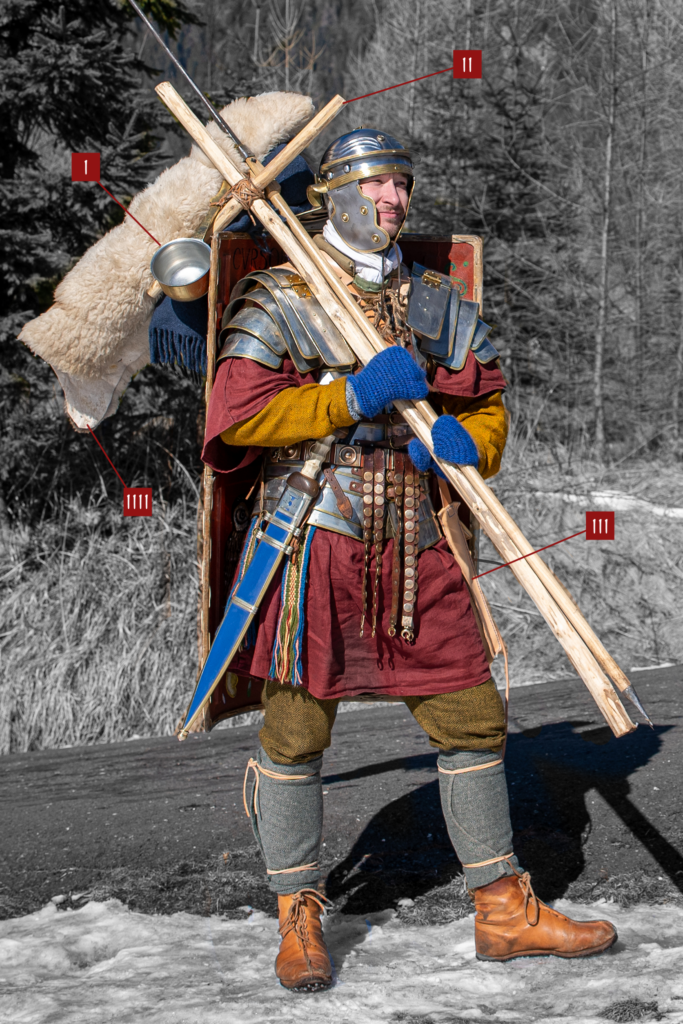
The patera was a bronze pan with a handle carried by a Roman soldier on the march. It was used for heating water, cooking, and eating — a practical part of every legionary’s equipment.
The furca was a wooden pole on which a Roman soldier carried his equipment while on the march. Over his shoulder, he carried a bundle with personal belongings, eating utensils, and a blanket — a symbol of the legionary’s life in the field.
The loculus was a leather satchel carried by a Roman soldier, either over the shoulder or on the furca. It was used to store personal belongings, tools, and food — an essential part of marching equipment.
Impedimenta dormiendi refers to a Roman soldier’s sleeping equipment — a blanket, sagum, hides, or straw. Carried on the furca, it formed an essential part of the soldier’s gear both on the march and in camp.
Legionary
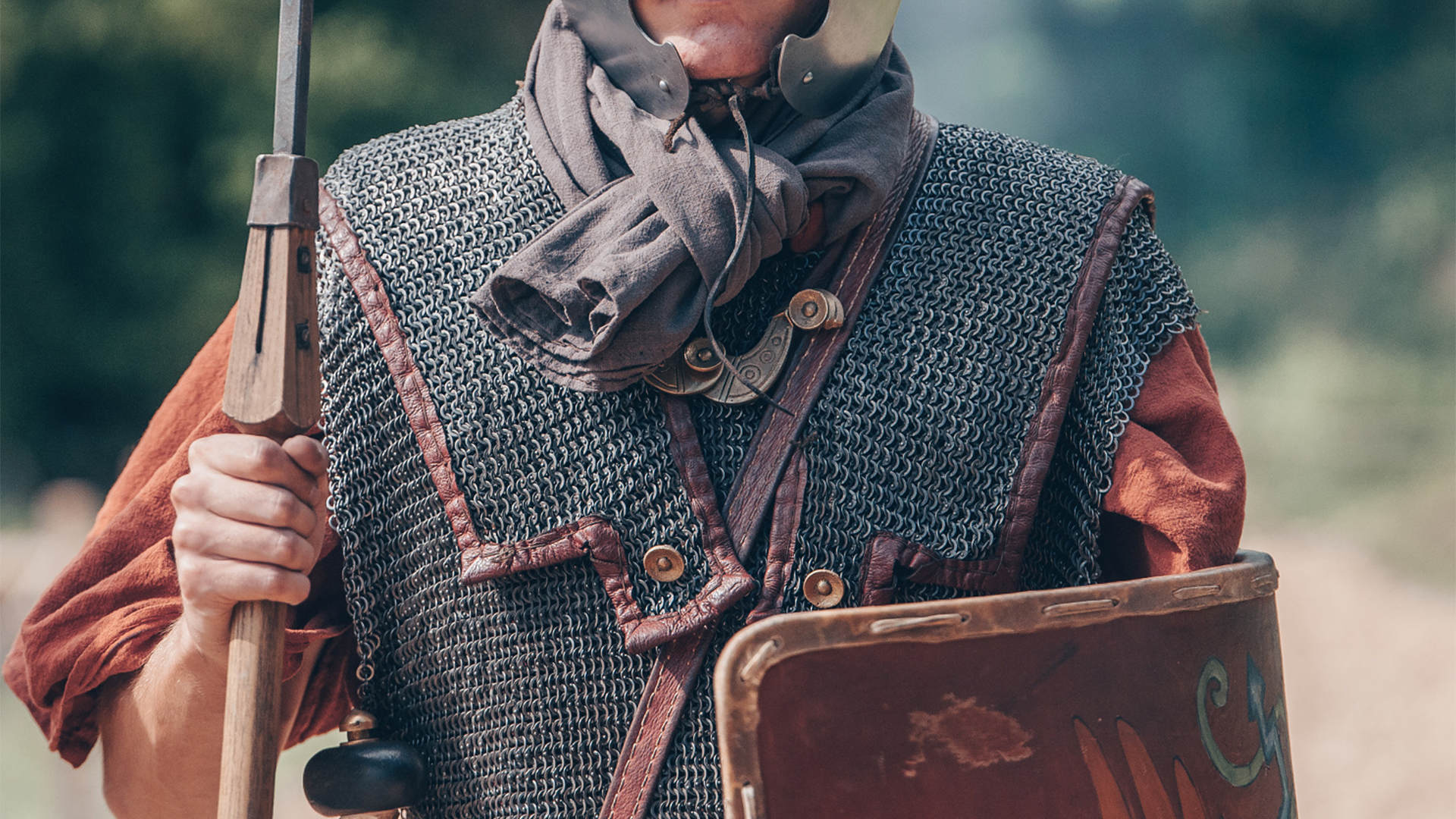
The legionary represents a heavily equipped soldier of a Roman legion. His equipment includes a helmet, armour, scutum shield, gladius sword, pilum javelin, and military belt. Together, these formed a system designed for combat, discipline, and service in the Roman army.
The pilum was a heavy javelin used by Roman legionaries as a ranged weapon, usually thrown before close combat. It had a long iron shank with a pyramidal point attached to a wooden shaft and was designed to bend on impact, making it difficult for the enemy to remove it from a shield.
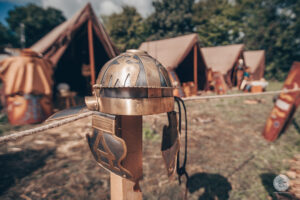
The galea, also known as the cassis, was a helmet worn by Roman legionaries. It was a key piece of protective equipment, usually made of bronze or iron and designed to protect the soldier’s head in battle. The galea was more than just protection; it could also serve as a symbol of rank and helped soldiers identify one another in the chaos of combat.
Lorica squamata was a type of armour made from small metal scales sewn onto a fabric backing. It was a common alternative to mail armour (lorica hamata) and offered better protection against blunt-force injuries. Although no complete lorica squamata has been found, many fragments and individual scales have been discovered, indicating its widespread use.
The scutum was a rectangular, curved shield used by the Roman army, especially by legionaries. It was designed for both defence and offence, providing protection while also being used to strike and push back enemies.
In ancient Rome, the cingulum militare was a decorated leather belt worn by Roman soldiers, serving both practical and symbolic purposes. It was an essential part of the military uniform, used to fasten garments, secure weapons such as the gladius sword and pugio dagger, and distinguish soldiers from civilians.
The gladius was a short sword, usually about 60 cm long, which served for centuries as the main weapon of Roman legionaries. It was known for its effectiveness in both thrusting and cutting attacks, making it a versatile weapon for close combat. The gladius was adopted by the Roman army after being used by Celtiberian warriors on the Iberian Peninsula.
In ancient Rome, the *tunica manicata* was a specific type of long-sleeved tunic. It probably became popular through contact and trade with Celtic and Germanic peoples, who wore similar styles. These groups often wore long-sleeved tunics reaching to mid-thigh or down to the knees.
These leg wraps, usually made of wool, were strips of fabric wrapped around the lower legs, providing insulation and helping to keep mud and dirt from sticking to the trousers.

Batavian Auxiliary Cavalryman
The Batavians were known as skilled warriors and horsemen from the northwestern provinces of the Roman Empire. In the Roman army, they carried out tasks connected with reconnaissance, rapid movement, flank protection, and mounted combat. Their equipment may have combined Roman military elements with regional traditions and the specific features of auxiliary units.

The draco (“dragon” or “serpent”, plural *dracones*) was a military standard of the Roman cavalry. Carried by a *draconarius*, the *draco* served as the standard of a cohort, just as the eagle (*aquila*) was the standard of a legion.
The pugio was a dagger used by Roman soldiers as a ready sidearm, primarily for close combat and potentially also as a utility tool. It was a common part of Roman military equipment and developed from daggers used by the Cantabrians in Iberia. Although the pugio was often regarded as a backup weapon, it was also a symbol of Roman manhood and military status.
The Batavians were a Germanic tribe living in close proximity to other groups that used the Germanic long knife. They shared cultural and linguistic ties with these tribes, suggesting that the Batavians probably adopted this weapon as well.
In the Roman army, the *parma* was a round or oval shield used mainly by auxiliary troops, including cavalry, as well as by standard-bearers. While legionaries initially preferred the heavier rectangular shield, the *parma* became more common later in the Empire, especially with the rise of cavalry and the need for more mobile warfare.
Command
The command of a Roman unit was not made up only of high-ranking officers. The everyday running of a century was ensured by experienced soldiers with specific roles — from the centurion and his deputy, the optio, to the bearer of the unit standard. Their equipment, symbols, and gear reflected their authority, responsibility, and role in command during marches, training, and battle.
Roman Centurion
The centurion was an experienced officer of the Roman army and commander of a century. On the battlefield and in camp, he was responsible for training, discipline, command, and the daily functioning of the unit.
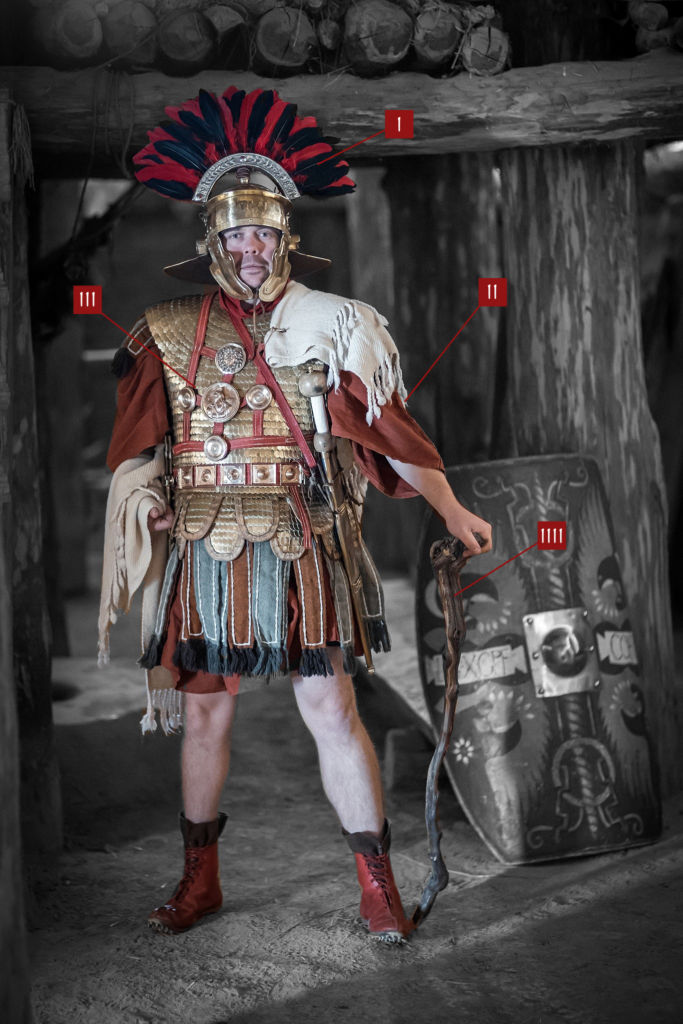
The crest on a Roman centurion’s helmet, known as the crista transversa, was usually made of horsehair or feathers and ran horizontally across the helmet. It served to clearly distinguish the commander on the battlefield and was a symbol of rank, courage, and command authority.
Phalerae byly kovové ozdoby nošené na hrudi jako vyznamenání za statečnost a zásluhy. Centurioni je nosili při slavnostech – symbolizovaly čest, prestiž a vojenské úspěchy.
The vitis was a vine staff, the symbol of a centurion’s rank. It served both as a sign of command and as a tool for maintaining discipline. Made from grapevine wood, it represented the authority and responsibility of the commander.
Deputy to the Centurion
The optio was the deputy of the centurion and one of the key junior command roles in a Roman unit. He helped maintain order, transmit commands, and support leadership during training, marching, and battle.
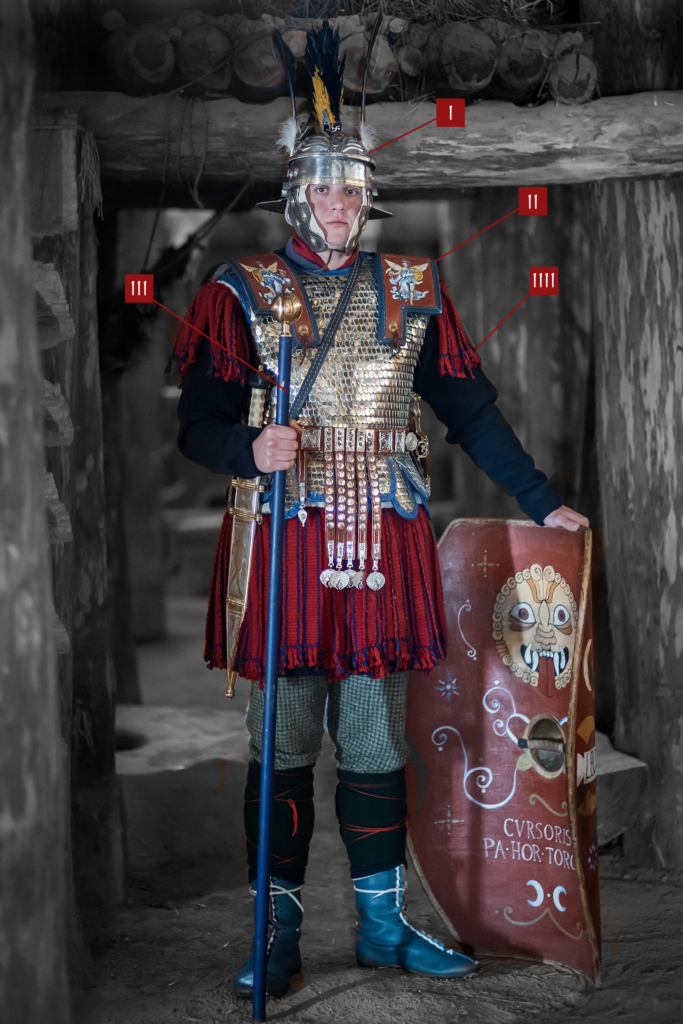
The crista sagittata was the longitudinal crest of an optio’s helmet, a distinctive mark of his rank. Officers’ helmets could also be decorated with side feathers — pinnulae — as a symbol of prestige and command role.
A wooden staff used to maintain order and discipline within the ranks. It was a symbol of the optio’s rank, similar to the centurion’s vitis, and helped him direct the unit.
The pteryges were woollen or linen strips attached to the shoulders and waist of Roman armour. They protected vulnerable areas without restricting movement, and on officers’ armour they were often decorated with colours, painted designs, or metal fittings.
Standard Bearer
The vexillifer carried the vexillum, the military standard. The standard served as a point of orientation, a symbol of identity, and an important command marker. The role of standard bearer was prestigious position in the Roman army.
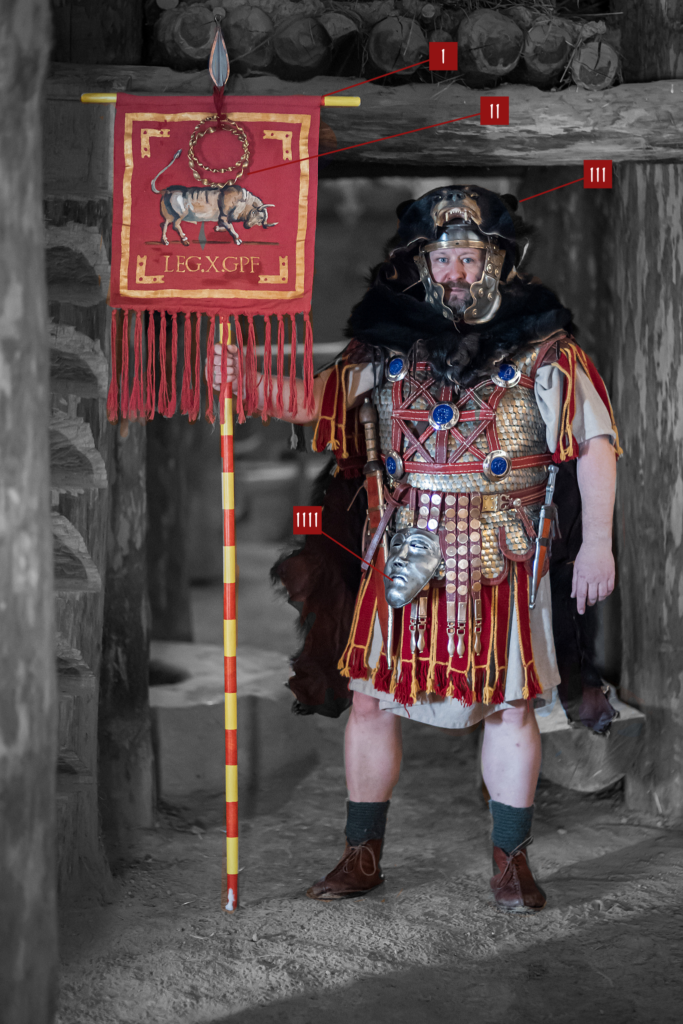
The vexillum was a square banner attached to a crossbar on a spear or pole. It served as the standard of a legion, cohort, or detachment. It was an important symbol of the unit and a point of reference both on the march and in battle.
The pellis was an animal skin worn over the helmet and shoulders of the vexilifer. It was most often a bear, wolf, or lion skin, symbolizing courage and special status while making the standard-bearer clearly visible.
The persona was a metal mask worn with a Roman helmet, especially by cavalry units during ceremonies and games. It covered the entire face and gave the wearer an idealized, almost divine appearance.
Would you like to see the equipment in person?
We use our equipment at historical events, Roman military demonstrations, and living history programmes. Follow the events connected with the project Castellum Felix or see the list of cultural events we are part of in current season.